OpenClaw Alternatives for Coding Agents (2026)
Compare 11 OpenClaw alternatives for developers who run Claude Code or Codex: where each agent runs, phone approvals, multi-computer support and cost.
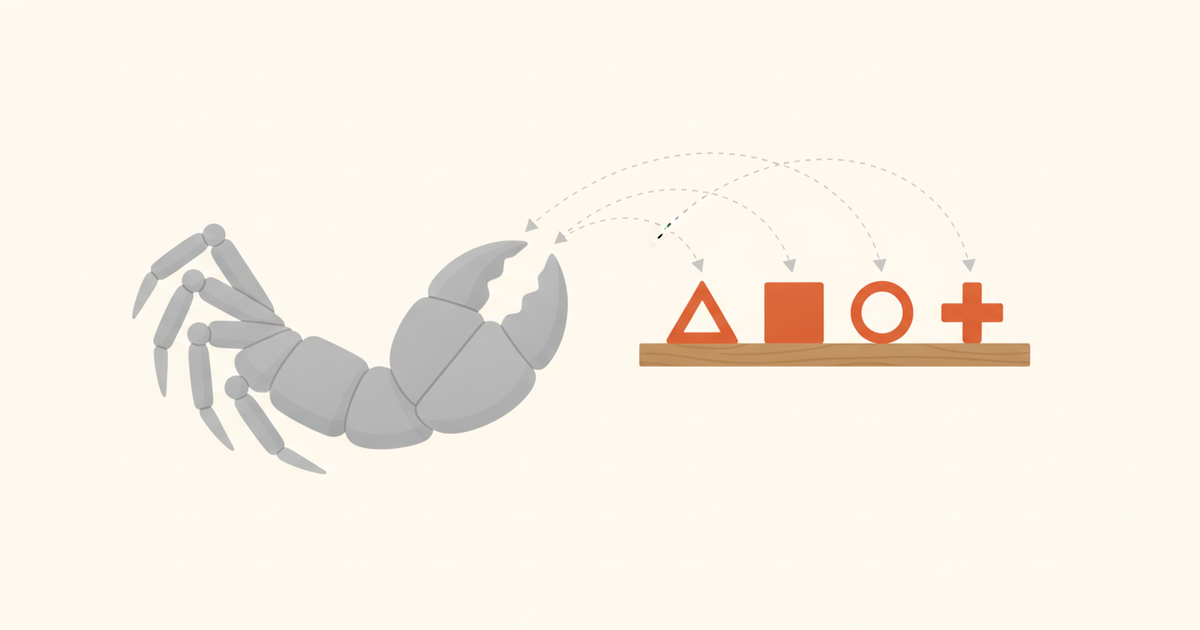
The best OpenClaw alternative depends on whether your real work happens in Claude Code or Codex sessions. If it does, look first at tools that keep those agents as the worker: Claude Code Remote Control with Channels, Happy, OpenHands Agent Canvas and NanoClaw. If you want a general personal assistant instead, Hermes Agent is the closest like-for-like replacement, IronClaw runs tools in WebAssembly sandboxes, and ZeroClaw packs 30+ channel adapters into one Rust binary; Nanobot and PicoClaw are lighter, and Moltworker runs OpenClaw itself on Cloudflare.
This guide is written by the Super Agent team. We build one of the options covered below, and Super Agent is built on the Super-Agent design DeepSeek published, so we have a stake in the topic. Every fact about other tools links to its source.
Key Takeaways
OpenClaw is a capable, MIT-licensed personal assistant with 29 messaging channels, but it is built around models you connect, not around your Claude Code or Codex sessions.
Documented security findings (a top skill Cisco called "functionally malware," a critical 9.9 advisory, a 2.0 sandbox that is off by default) are the clearest reasons to look at alternatives.
For coding agents, judge each option on five points: worker, where it runs, phone approvals, multi-computer support and cost.
Claude Code Remote Control and Happy are the shortest path to steering an existing agent from your phone; OpenHands Agent Canvas and Hermes Agent cover remote and cloud backends.
Why developers look for an OpenClaw alternative
The documented reasons to look elsewhere are about how much OpenClaw can reach, not what it can do. Developers have a second reason: OpenClaw is a general assistant, not a tool built around Claude Code or Codex sessions.
OpenClaw deserves its popularity. It runs on your own computer and keeps state, memory and credentials on your hardware. It's MIT-licensed and stewarded by the independent OpenClaw Foundation, with no paid tier or token (GitHub). It works inside WhatsApp, Telegram, Slack, iMessage "or any of its 29 channels," with community skills through ClawHub and hosted, subscription or local models (openclaw.ai). The foundation shipped 2.0 on August 30, 2026 (Wikipedia).
The documented concerns are specific:
- Skills from the marketplace. In January 2026, Cisco tested a third-party skill pushed to the top of the skill repository and found nine issues, two critical, including silent data exfiltration via curl. Cisco called it "functionally malware" (Cisco Blogs).
- A critical advisory. GHSA-4jpw-hj22-2xmc, rated Critical with CVSS 9.9, let pairing-scoped device tokens mint admin-scope tokens and reach remote code execution. It affected npm openclaw before 2026.3.11, which patched it.
- 2.0 defaults. The Register's review quoted patch notes saying shared cloud sessions "are not tenant isolation or a security boundary," reported that "Secret Store values are not encrypted at rest," and noted the new sandbox is off by default (The Register).
- Size. NanoClaw, a competitor, claims OpenClaw has 434,453 lines across 3,680 files and takes one to two weeks to understand, versus about 29,300 lines for NanoClaw (nanoclaw.dev). Treat that as a rival's framing.
OpenClaw's own README is clear about the model: inbound messages are untrusted input, unknown DM senders need pairing approval, and tools run on the host for the main session unless you configure sandboxing (GitHub). On a machine that holds client repos and SSH keys, that default matters most.
How we compared them
We judged every tool on five things that matter when the real work is a coding agent session: whether it keeps Claude Code or Codex as the worker, where the agent runs, how you reach it and approve tool calls from your phone, whether one interface covers several computers, and what it costs in software and models.
GitHub star counts are approximate, as of November 2026. Tool facts come from each project's README, site or docs; security findings come from Cisco, The Register and GitHub's advisory database.
| Tool | Keeps Claude Code / Codex? | Where the agent runs | Remote control surface | Several computers | Cost |
|---|---|---|---|---|---|
| OpenClaw (baseline) | Connects models directly | Your computer; host by default | 29 messaging channels | Not documented | Free (MIT) + models |
| Hermes Agent | Imports their config; runs its own agent | Local, Docker, SSH, Modal, Daytona, Vercel Sandbox | Telegram, Discord, Slack, WhatsApp, Signal, Email | Via SSH and cloud backends | Free (MIT) + models |
| NanoClaw | Claude Agent SDK default; Codex selectable | Docker container per agent | Channel skills (WhatsApp, Telegram, Slack and more) | Not documented | Free + model usage |
| Claude Code Remote Control + Channels | Is Claude Code | Your machine | Claude app, claude.ai/code, Telegram/Discord/iMessage | One machine per session | Claude Pro, Max, Ultra, Team or Enterprise plan |
| Happy | Claude Code, Codex, Grok and more | Your computer | iOS, Android, web, desktop apps | Not documented | Free (MIT), reuses subscriptions |
| OpenHands Agent Canvas | Claude Code, Codex and more | Local, remote or cloud backends | Self-hosted control center; Slack, GitHub, Linear | Via remote backends | Free (MIT); Cloud is commercial |
| IronClaw | Own agent | Host, tools in WASM sandboxes | REPL, web gateway, Telegram, Slack | Not documented | Free (MIT/Apache-2.0) + models |
| ZeroClaw | Own runtime, 20+ providers | Single binary on your host | 30+ channel adapters | Not documented | Free (MIT/Apache-2.0) + models |
| Super Agent | Claude Code, Codex, Grok | Your own computers | Any browser or phone; Telegram/WeChat on Pro | Yes | Free; Pro $14.90/month |
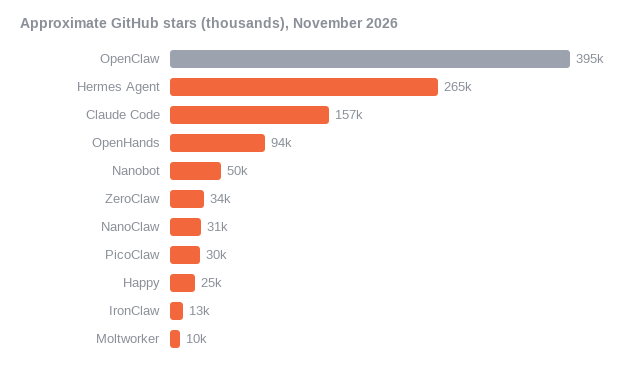
Source: GitHub repository pages, retrieved November 22, 2026.
The OpenClaw alternatives, one by one
Hermes Agent (Nous Research)
Hermes Agent is the closest like-for-like replacement and the easiest move if you already run OpenClaw. It writes and refines its own skills, keeps persistent memory, searches past sessions and works with any model provider. One gateway serves Telegram, Discord, Slack, WhatsApp, Signal, Email and a CLI/TUI. It's MIT-licensed with about 265k stars (GitHub).
hermes setup offers to import from OpenClaw, Claude Code, Codex CLI or Cursor, bringing memories, skills, command allowlists and AGENTS.md; API keys move only with --migrate-secrets. Six terminal backends (local, Docker, SSH, Modal, Daytona, Vercel Sandbox) mean the agent doesn't have to run on your laptop. Note that Hermes imports from Claude Code rather than driving it: Hermes becomes the agent.
NanoClaw (NanoCo)
NanoClaw is the pick if isolation is your main worry and you still want Claude doing the work. Each agent runs in its own Docker container and only sees what you explicitly mount, while a credential gateway injects keys so agents never hold raw API keys. It runs Claude through Anthropic's Claude Agent SDK by default, with Codex, Cursor or OpenCode selectable per agent group (GitHub).
Channels arrive as /add-<channel> skills, covering WhatsApp, Telegram, Slack, Discord, Teams, Signal, iMessage, Matrix, GitHub, Linear and email. You need macOS or Linux (Windows via WSL2), about 4GB of RAM and Docker. The software is free; you pay for model usage through a Claude API key or subscription, Codex, or Ollama locally (nanoclaw.dev). MIT, about 31k stars.
Claude Code Remote Control + Channels (Anthropic)
If Claude Code is your agent, the built-in features may be all you need, and they're the direct answer to "OpenClaw vs Claude Code." Remote Control connects claude.ai/code or the Claude iOS and Android apps to a session on your machine. Execution and files stay local, it uses outbound HTTPS only, and server mode serves up to 32 concurrent sessions by default. It needs a Pro, Max, Ultra, Team or Enterprise plan; API keys aren't supported.
Channels, a research preview, lets an MCP server push events into a running session, with Telegram, Discord and iMessage plugins included. Channels that declare "permission relay" can forward tool-approval prompts to your phone, which is the OpenClaw chat-app experience with Claude Code as the worker. Events only arrive while the session is open. Our Claude Code Remote Control guide covers setup and common errors.
Happy (formerly Happy Coder)
Happy is a free app that puts Claude Code, Codex and other agents on your phone. Install it with npm install -g happy, then start happy claude or happy codex, and the session carries over to the iOS, Android, web or desktop app. It supports Claude Code, Codex, Grok, Gemini via Antigravity, OpenCode or any ACP agent. Traffic between devices is end-to-end encrypted through a relay server, and invited collaborators can watch and steer the same agent (GitHub).
It reuses your existing subscriptions; the project describes itself as adding "a harness, not another bill." MIT, about 25k stars.
OpenHands Agent Canvas
Agent Canvas is "the self-hosted developer control center for coding agents and automations." It runs OpenHands, Claude Code, Codex, Gemini, OpenCode or any ACP agent on local, remote or cloud backends, and adds scheduled or webhook automations with Slack, GitHub and Linear (GitHub).
The npm install (npm install -g @openhands/agent-canvas) has no sandbox, so the agent gets full filesystem access. For isolation, use the Docker image or set OH_CONVERSATION_RUNTIME=docker for per-conversation containers. It binds to 127.0.0.1 by default. OpenHands Cloud is the commercial version. MIT, about 94k stars.
IronClaw (NEAR AI)
IronClaw is a Rust rewrite inspired by OpenClaw, built around a security-first design. Untrusted tools run in WebAssembly sandboxes with opt-in capabilities, secrets are injected at the host boundary and never exposed to WASM code, HTTP goes only to allowlisted endpoints, secrets are encrypted with AES-256-GCM and every tool run is audit-logged (GitHub). Channels are narrower: REPL, webhooks, a web gateway, Telegram and Slack. It uses PostgreSQL and runs its own agent rather than Claude Code. MIT/Apache-2.0, about 13k stars.
ZeroClaw (ZeroClaw Labs)
ZeroClaw is a self-hosted agent runtime shipped as a single Rust binary, with 20+ LLM providers, shell, browser, HTTP, hardware and MCP tools, and 30+ channel adapters. zeroclaw quickstart gets you running and zeroclaw service install keeps it always on (GitHub). Choose it when you want OpenClaw's channel breadth in one binary. MIT/Apache-2.0, about 34k stars.
Lightweight options: Nanobot, PicoClaw, Moltworker
These suit a small personal assistant more than a coding workflow:
- Nanobot (HKUDS): Python 3.11+, WebUI and TUI, 15+ chat apps including Feishu and WeChat, MCP with built-in OAuth.
pip install nanobot-ai. MIT, about 50k stars. - PicoClaw (Sipeed): a Go single binary that claims to run "on $10 hardware with <10MB RAM" (the README notes recent builds may use 10–20MB) across RISC-V, ARM, MIPS, x86 and LoongArch. The project says it's in early development and not for production before v1.0. MIT, about 30k stars.
- Moltworker (Cloudflare): runs OpenClaw itself in a Cloudflare Sandbox container. It's a proof of concept "not officially supported and may break without notice," needs Workers Paid ($5/month) and an Anthropic API key (or AI Gateway), and the README estimates about $34.50/month to run the default instance 24/7.
Super Agent (ours)
Super Agent is for developers who run Claude Code, Codex or Grok on more than one computer. It follows the super agent pattern: you connect each computer with the open-source, MIT-licensed crewbot connector (npx crewbot start, Node.js 22+), then create bots, each with its own computer, project folder and approval level. Work happens on your machines using the agents and subscriptions already signed in there, and only the conversation syncs online. Edits and commands that need permission show up for approval on whichever device is closest. The connector makes one outgoing connection and never listens on a port.
The free plan covers connecting computers, bots and remote approvals from any browser or phone. Pro ($14.90/month) adds the Super Agent assistant, which hands your requests to the right bot and reports back, plus Telegram and WeChat access and schedules. For the always-on setup, see building a 24/7 super agent.
Which OpenClaw alternative should you pick?
Pick by the job, not the star count. Say you start a long refactor on your desktop and want to approve its file edits from your phone on the way home: any option in the first two bullets handles that.
- You only use Claude Code and want your phone: Claude Code Remote Control, plus Channels if you want Telegram or Discord.
- You switch between Claude Code, Codex and other agents: Happy for a phone app, or OpenHands Agent Canvas for a self-hosted control center.
- Agents should run off your laptop: Hermes Agent's SSH and cloud backends, or Agent Canvas remote backends.
- Isolation comes first: NanoClaw's per-agent containers or IronClaw's WASM sandboxes.
- You want OpenClaw's features with less migration work: Hermes Agent, which imports your OpenClaw setup.
Frequently Asked Questions
Is OpenClaw safe to use?
It can be, with care: run 2026.3.11 or later, which patched GHSA-4jpw-hj22-2xmc, vet third-party skills, and configure sandboxing, since tools run on the host for the main session by default. On 2.0, don't treat shared cloud sessions as a security boundary, and note that Secret Store values aren't encrypted at rest (The Register).
Can I use Claude Code instead of OpenClaw?
Yes, for coding work. Remote Control and Channels cover phone access and approvals for Claude Code sessions, though they don't replace OpenClaw's broader assistant role.
Is there a lighter OpenClaw alternative?
Yes. NanoClaw claims a far smaller codebase, ZeroClaw is a single Rust binary, Nanobot is a lightweight Python agent, and PicoClaw targets cheap hardware but isn't production-ready before v1.0.
Do these alternatives need my own API key?
Mostly you bring your own model access. Remote Control needs a Claude plan and doesn't accept API keys, Happy reuses your subscriptions, NanoClaw takes a key, subscription or local Ollama, and Moltworker needs an Anthropic API key (or AI Gateway).
Conclusion
OpenClaw is a strong general assistant, but if your work lives in Claude Code or Codex sessions, pick an alternative that keeps them as the worker and gives you approvals you can trust from your phone. If you run those agents across several computers, try Super Agent free.