
DeepSeek Super-agent Design, Explained
DeepSeek's Super-agent design and dsh-superagent prototype explained: Router and Worker layers, Tickets, observe mode, and what the early test shows.

The DeepSeek Super-agent is a design for an always-on agent system, not a new model. On 2026-10-31 the DeepSeek Harness team published the design article 《Super-agent 设计探索:迈向更自主的 Agent 系统》 ("Exploring Super-agent Design: Towards a More Autonomous Agent System") on its WeChat account, as IT之家 reported the same day. Alongside it, the team open-sourced a research prototype, dsh-superagent-prototype, under the MIT license.
The core idea is a two-layer system. A Router talks to people and keeps the global context. Workers do the actual tasks in isolated sessions and report back to the Router instead of to you. This explainer covers what the article proposes, how the prototype implements it, what the experiment does and does not show, and which problems DeepSeek says are still open. For the broader concept, see what is a super agent.
This guide is written by the Super Agent team. Super Agent is built on the Super-agent design DeepSeek published, so we have a stake in the topic.
Key Takeaways
DeepSeek's Super-agent splits an agent into a Router layer that handles people and a Worker layer that runs tasks in parallel, isolated sessions.
The design targets human attention: DeepSeek observed that one person can usually follow only 3 to 5 active sessions at once.
The open-source dsh-superagent prototype is a coding agent for one GitHub repository, packaged for DeepSeek Harness, and it is "not an official DeepSeek product."
Proactive work starts in
observemode by default, which records what the agent would have done without doing it.In a synthetic test, Super-agent finished work requests at p50 12.4 and p95 15.7 minutes, versus p95 29.5 minutes for a single session with a neutral prompt.
What problem does the DeepSeek Super-agent target?
The bottleneck it targets is human attention, not model capability. According to the IT之家 summary, as models need less human help on single tasks, the limit on productivity shifts to the person managing them.
Most agent designs today treat one session as the basic unit, and sessions are independent of each other. If you run several pieces of work in parallel, you switch between sessions and keep each one's context in your head. DeepSeek's team observed that a person can usually follow only 3 to 5 active sessions at a time (IT之家).
Extending a local agent with a CLI, MCP or external connectors does not remove the problem, the article argues. You can still hit synchronous blocking inside one session, mixed-up context across tasks, and work that stops when the local device goes offline.
The four properties of a Super-agent
DeepSeek defines a Super-agent by four basic properties: continuous, efficient, proactive and persistent (IT之家).
- Continuous: you can talk to the same agent across channels, such as an IM group chat and GitHub comments, and one task can move between them.
- Efficient: it handles several complex tasks in parallel.
- Proactive: it keeps watching environment events and moves forward on items worth handling. One example in the article shows the agent spotting a bug in a public group chat, without anyone @-mentioning the agent, and opening a fix pull request.
- Persistent: it stays online and can recover from abnormal states during long runs.
The five parts of the architecture
The architecture has five parts: the two-layer design, event-driven input, human-facing interaction, separation of compute, state and environment, and a Watchdog (IT之家).
Two layers: Router and Workers
The Router layer takes human interaction, maintains global context and dispatches tasks. Workers run concurrently in isolated sessions. A Worker never replies to the user directly; it reports status and results to the Router, which handles all outward communication.
Event-driven input
External signals such as chat messages, email and calendar reminders, code review comments and CI results are called Triggers. Program rules filter them first, then a model judges whether action is needed. Once a task owns an event stream, its Worker can subscribe to that Thread, so later events go straight to the Worker instead of passing through the Router each time, which lowers routing load.
The article also describes two context mechanisms. Inline & Spill keeps likely-needed information inside the context window and leaves over-budget or rarely used content outside it for on-demand reads. Chain of Recall lets the model follow ID references between Triggers, Threads and Worker sessions to recover past task history. A third idea, speculative execution, starts work early from environment signals, for example checking calendar conflicts and drafting a reply when a meeting invite arrives.
Human-facing interaction
To keep the conversation responsive, the article proposes an async ReAct loop: slow tool calls become asynchronous start() and stop() calls, the agent returns a Started status, and the result arrives later as a new event. DeepSeek notes this mechanism is implemented in DeepSeek Harness but is not turned on by default.
Compute, state and environment, separated
Compute and persistent state live in the cloud, while the execution environment can stay on your own machine, running only a lightweight daemon that executes commands and returns results. DeepSeek calls this BYOM (Bring Your Own Machine). It also supports hosted cloud machines or on-demand environments.
Watchdog
A separate Watchdog session forms an outer control loop. It watches infrastructure errors and failed recoveries, and also uses a model to judge whether Workers are making real progress or drifting off target, and intervenes to repair problems it finds.
How the dsh-superagent prototype implements the design
The prototype is a narrower, concrete version of the design. Its README describes it as "a proactive coding agent for one GitHub repository, packaged as a bundle for DeepSeek Harness." It listens to GitHub and, optionally, Feishu, works on each request in its own session and directory, and answers in the original conversation, for example with a pull request.
The core concepts
The domain model names a small set of concepts. Work flows from Trigger to Eval to execution.
| Concept | What it is in the prototype |
|---|---|
| Source | A stream of events, such as GitHub or Feishu |
| Trigger | One immutable event from a Source |
| Thread | Triggers in time order, such as one Issue or one chat topic |
| Eval | The judgement on a batch of Triggers: a deterministic gate, then a model assessment |
| Ticket | A unit of authorized work; only Eval creates one |
| Mandate | What an accept grants: Policy version, scope and strength |
| Subscription | The link between a Ticket and a Thread, so later discussion reaches the work |
| Executor | Outside the domain: runs the work, with one Executor Session and one directory per Ticket, connected through an Assignment |
Source, Thread, Eval, Mandate and Subscription form the core domain.
Router session and worker sessions
The main Session evaluates Triggers, accepts and dispatches Tickets, and replies. It uses the dsh-superagent-router preset with a smaller, routing-focused tool set. Each Ticket gets its own Executor Session named worker-<ticket id>, using the dsh-superagent-worker preset (003 Execution).
The worker preset moves foreground shell commands to background jobs after 5 seconds, and the router preset uses the same 5-second shell and job-wait limits. That lets a worker take a new message at its next step instead of waiting for a long command to finish, which reads like a simple form of the article's async idea. Executor Sessions run commands without approval as the operator's OS user, and the docs state plainly that the command wrappers and directories "establish defaults, not a security boundary."
Accept modes, with observe as the default
Explicit requests, from an allowed person who addresses the agent, work in every mode. Proactive, or "inferred", work depends on the accept mode (002 Authorization):
off: nothing inferred becomes a candidate.observe(default): inferred candidates are assessed, and a positive result is recorded as an ignore Decision marked "would accept". Nothing is accepted.auto: a positive assessment accepts the work.
The docs recommend starting in observe and switching to auto after reviewing the recorded Decisions. Every proactive accept also needs at least one matching rule that the team wrote.
The philosophy behind it
The project states one principle in its philosophy document: "Take as little human attention as possible, and give as much value as possible." In practice the agent acts only when asked or when a written rule allows it, confirms a request once, stays quiet while working, and writes again only when a result is ready, it needs a decision, or it cannot finish.
Scope and requirements of the prototype
The prototype covers one github.com repository, with Feishu chats as an optional second Source. It runs on DeepSeek Harness as a bundle, and setup is meant to be done by a coding agent that follows SETUP.md with you.
The listed prerequisites are Node.js 22.19+ or 24+, pnpm, git 2.32+, tmux, Python 3.8+, GitHub CLI 2.48+, and DSH within the version range in package.json, plus a model provider configured for DSH. Setup recommends a dedicated GitHub account for the agent, never the operator's own.
Two caveats from the README matter. It is a "Research prototype for reference only, not an official DeepSeek product." It has also been adapted for publication, so it is not identical to DeepSeek's internal version or to the implementation the article describes, and some designs in the article are future directions not built into the prototype.
What the experiment shows, and what it does not
DeepSeek ran a preliminary experiment comparing four setups: Super-agent, Super-agent without event pass-through, and a single session plus subagents under two prompt configurations (IT之家). Each run had about 300 messages, about 20 of them work requests, and each setup ran 5 times.
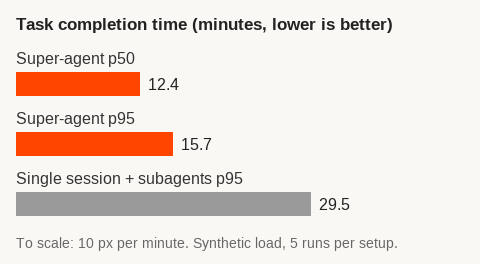
Source: DeepSeek Harness team via IT之家, 2026-10-31; synthetic load
Super-agent completed work requests at a p50 of 12.4 minutes and a p95 of 15.7 minutes. The single-session setup with a neutral prompt had a p95 of 29.5 minutes. The IT之家 summary does not report the other setups' numbers, so they are not charted here (IT之家).
A separate Router stress test raised Trigger arrival from about 1 to about 40 per minute. Average batch size grew from 1.0 to 2.8 and per-request time from 2.5 to 3.9 seconds, while amortized inference time per decision fell from 6.4 to 1.6 seconds. DeepSeek reads this as the Router keeping throughput up during bursts by merging queued events (IT之家).
Read these results with their limits. The team says the tests used synthetic load and a simplified environment, and message intervals and work durations were scaled to 1/4 while model call times were real. They measure scheduling and coordination, not how well any single task is done (IT之家).
Open problems DeepSeek lists
DeepSeek is explicit that the design is unfinished. The open problems it names are scaling the Router layer as task volume grows, long-range memory over months or longer, human collaboration outside the session model, A2A communication between agent instances, and security and privacy (IT之家). Once a cloud agent reaches local devices, prompt injection, credential leaks on the device and cross-device permissions all need more work.
The team also says an internal Super-agent instance built on these ideas and DeepSeek Harness is already running continuously, helping with bug reproduction and fixes, code review responses and DeepSeek Harness's own development (IT之家).
From prototype to daily use
Because the article and prototype are public, anyone can build on the design; our build story shows what changes along the way. Whatever you build on, the prototype's docs are worth reading in order, since each one builds only on the ones before it.
Frequently Asked Questions
Is dsh-superagent an official DeepSeek product?
No. The README calls it a "Research prototype for reference only, not an official DeepSeek product." It is published by DeepSeek under the MIT license, but DeepSeek presents it as research code that may contain bugs and should be reviewed before use.
Do I need DeepSeek Harness to run it?
Yes. The prototype is packaged as a bundle for DeepSeek Harness, and SETUP.md lists DSH within the engines.dsh range of package.json as a prerequisite, along with a configured model provider.
What is observe mode?
It is the default accept mode for proactive work. The agent assesses inferred candidates and records a positive result as "would accept" without doing the work. Explicit requests from allowed people still run. You review the record, then switch to auto if the agent's judgement looks right.
Is Super Agent affiliated with DeepSeek?
No. Super Agent is an independent product built on the Super-agent design DeepSeek published. It is not official, endorsed by or partnered with DeepSeek.
To see how the design became a working product, read from architecture to product or try Super Agent.